Dilution Calculator (C1V1 = C2V2)
Calculates an unknown stock concentration, aliquot volume, final concentration or final volume when the quantity of solute is conserved.
Input Values
Results
Leave exactly one field empty. Use matching concentration units and matching volume units.
Formula And Worked Example
Formula
C1 × V1 = C2 × V2. Rearrangements: V1 = C2 × V2 ÷ C1; C2 = C1 × V1 ÷ V2; C1 = C2 × V2 ÷ V1; V2 = C1 × V1 ÷ C2. Dilution factor = C1 ÷ C2.
Worked Example
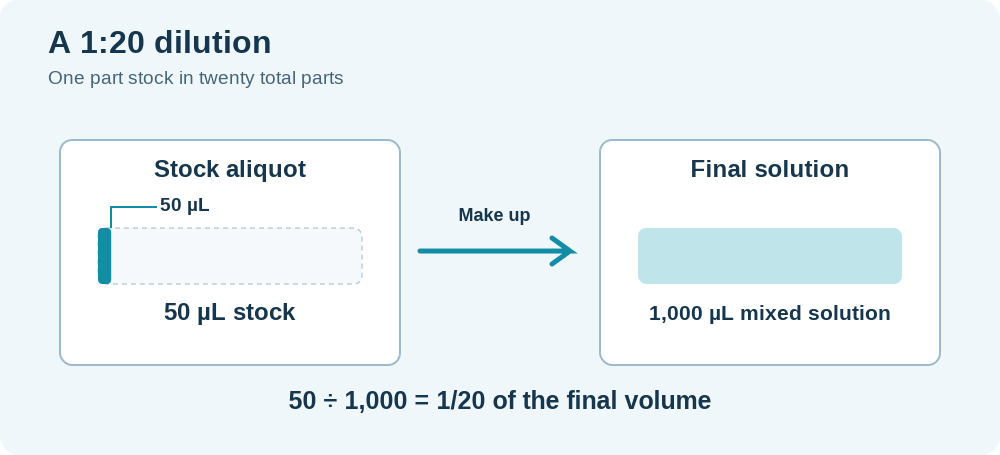
To prepare 1.00 mL of a 10 mg/mL solution from a 200 mg/mL stock, V1 = 10 × 1 ÷ 200 = 0.05 mL (50 µL). Bring to 1.00 mL final volume. This is a 1:20 dilution: one part stock in twenty total parts.
Inputs And Units
C1 (stock concentration), V1 (stock volume), C2 (final concentration), V2 (final volume). Enter three values and leave exactly one unknown; use matching concentration units and matching volume units.
Interpretation And Limits
For an ordinary dilution, the stock volume must be positive and cannot exceed the final volume; the target concentration cannot exceed the stock concentration. The equation itself does not guarantee a physically possible preparation. Use a compatible diluent and suitable volumetric equipment; confirm permitted dilution, linearity and any analyzer dilution correction. Adding an arbitrary volume of solvent is not always equivalent to making up to a defined final volume. When both concentrations are zero, the equation cannot determine a missing volume. A zero final concentration also makes the concentration-based dilution factor undefined.