Daily Laboratory QC: A Step-by-Step Bench Routine
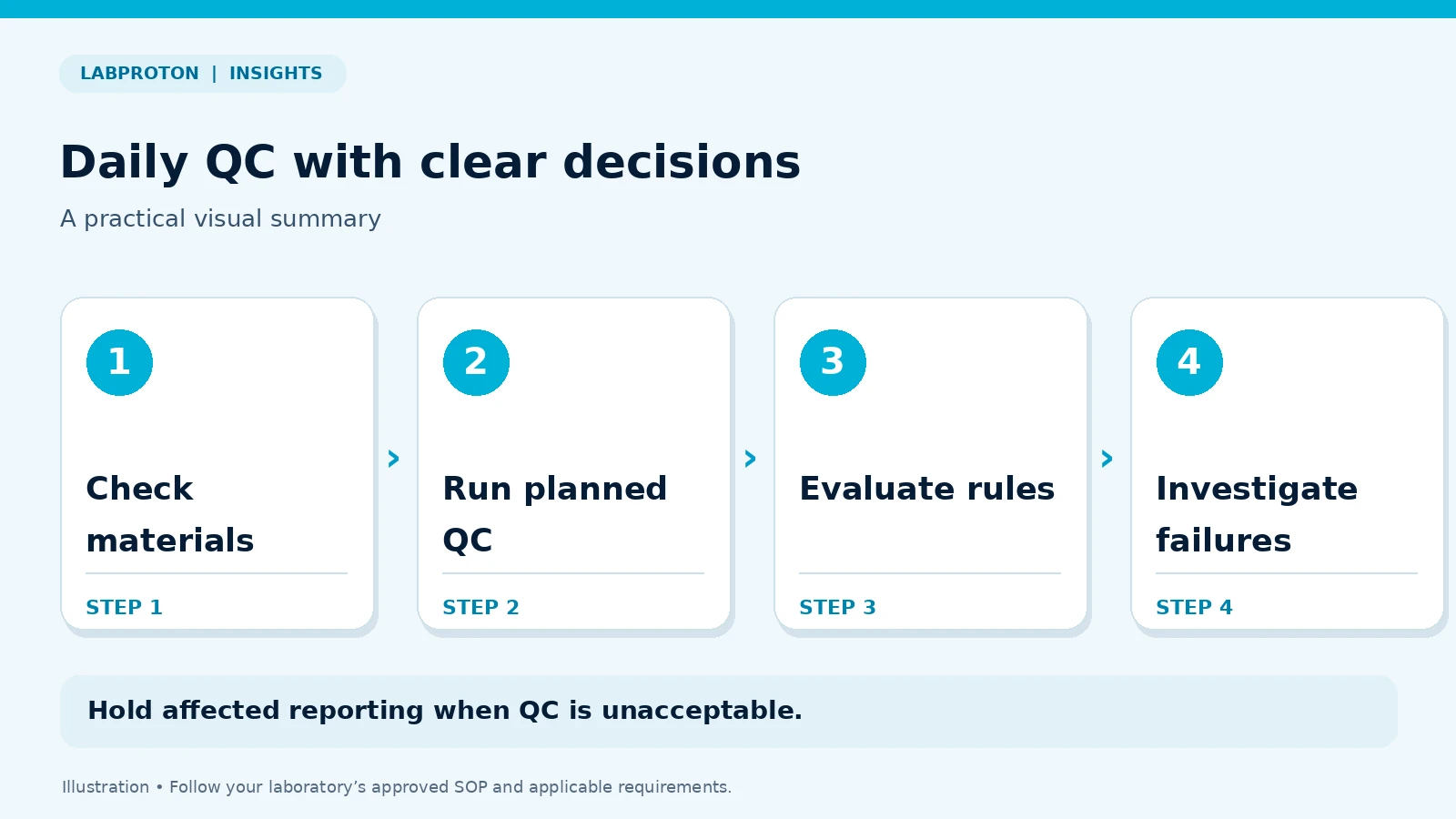
A practical daily QC workflow: check materials, apply approved acceptance rules, investigate failures, and document decisions.

Routine internal quality control (QC) is not a ritual performed simply because the analyzer asks for it. It is a check that the measurement system is behaving acceptably for the patient results the laboratory plans to report. The precise schedule, number of levels, limits, and response rules must come from a documented QC plan suited to the method and local requirements.
Use this guide as a bench workflow framework, not a substitute for the manufacturer's instructions or your laboratory's approved SOP.
Before the run: check the materials
Confirm the instrument is ready for use and relevant maintenance is complete. Check control material identity, lot number, expiry, storage conditions, and open-vial or reconstituted stability. Follow the specified mixing, warming, and preparation steps. Record any unusual event, such as a power interruption or reagent-lot change, that might affect the run.
Do not assume that a control vial is suitable because it has been used successfully before. Wrong lot selection or improper storage can make the plotted result appear abnormal even if the analyzer itself is functioning correctly.
During the run: use the defined QC plan
Run the required controls at the appropriate frequency and decision levels. The schedule may differ between assays, instruments, and laboratories; not every method simply needs two controls every morning. Check that the software uses the correct active control lot, mean, SD or other acceptance limits, and rule set.
Compare the results with the laboratory's planned limits and recent history. A single point may be within its range while a run of results suggests a drift or shift. Interpret observations under the method's actual QC rules rather than relying solely on a green symbol.
If QC fails: stop, investigate, and document
When a rejection rule is met, follow the laboratory's policy to hold affected patient results. Check the control preparation, reagent or calibrator state, analyzer flags, recent maintenance, environmental conditions, and known failure patterns. Repeat a control only as part of an appropriate investigation. Repeatedly testing until a passing result appears can hide a genuine problem.
Record the first unacceptable result, the checks performed, the identified or probable cause, corrective action, and evidence that performance returned to acceptable limits. Assess whether results since the last acceptable QC may be affected. Authorized technical or medical leadership should determine whether any reported patient result requires review or amendment.
Restore routine work only after defined acceptance
An affected analytical method does not become acceptable simply because the error message disappeared. Follow the documented criteria for returning to service, including control testing and any additional verification required after maintenance or recalibration. Tell the next shift what happened if the event is not completely resolved.
If a control repeatedly fails at the same concentration but other levels look acceptable, do not assume the method is safe at every decision point. Review relevant concentrations, material problems, and the clinical importance of that range.
Finish with a record another person can understand
A strong QC record includes date/time, instrument and assay, control lot/level, observed result, acceptance decision, staff identification, and investigation of any failure. It should be possible for a supervisor to reconstruct the decision without needing to ask who remembers the shift.
Where electronic charting is available, ensure it preserves corrected entries and the original QC history. Where paper is used, write legibly and follow document-control rules. The point is traceability, not a particular technology.
A five-question bench check
- Are the controls and reagents suitable for use?
- Were the required levels and frequencies followed?
- Are the results acceptable under the approved rule set?
- Were any problems investigated and patient impact considered?
- Is the final decision documented and handed over if necessary?
The safest daily routine is predictable enough to follow under pressure and flexible enough to identify a real problem instead of treating every exception as an inconvenience.
Example: one out-of-control result at the start of a shift
A technologist runs the scheduled morning controls and one level meets a predefined rejection criterion. Instead of dismissing the alert and continuing to release patient results, the technologist follows the laboratory's QC failure procedure. They verify that the correct control lot and limits were selected, examine reagent and calibrator status, review recent maintenance, and inspect any instrument warning.
If control handling appears suspect, a fresh vial may be prepared and used according to the investigation plan. The team documents the initial result and each action, evaluates whether results since the last acceptable QC might be affected, and confirms acceptable performance before the affected method returns to routine reporting. A supervisor can later read the record and understand why the decision was made.
Avoid: repeatedly rerunning the same vial until a passing number appears, assuming all methods use identical QC frequency, or using a generic 'in range' label without considering trends and the approved rule set.
Common questions
Can I keep running patient samples after QC fails?
Follow the laboratory’s predefined hold and investigation policy. Results potentially affected by unacceptable QC must not be released until the method meets approved acceptance criteria or an authorized alternate process is followed.
How many control levels should be run each day?
There is no universal answer. Frequency, levels, and rules depend on the method, clinical risk, test volume, manufacturer guidance, and applicable requirements. Use the approved QC plan.
Reference leads
CLSI C24 statistical quality control guidance; WHO, *Laboratory Quality Management System: Handbook* (2011); current manufacturer instructions and local SOPs.

Levey–Jennings Charts and Westgard Rules, Explained
Learn how to read Levey–Jennings charts, interpret common Westgard QC signals, and investigate out-of-control results responsibly.
Read article →
Precision and Bias Verification: A Practical Introduction
A practical introduction to precision, CV%, bias, method verification design, acceptance criteria, and documented decisions.
Read article →
Specimen Accessioning and Labeling: Five Safe Steps
Follow five practical steps to match specimens and orders, check containers, apply barcodes, and document intake exceptions.
Read article →