Critical Results: Build a Safe Notification Workflow
Design a safer critical-result notification process with approved limits, timely checks, read-back, escalation, and clear documentation.

A critical laboratory result is one that may signal an immediate risk to a patient and requires prompt communication under an approved local policy. It is not enough to display the result in red or print an urgent report. Someone who can act on the information must receive it, understand it, and have a clear record of the communication.
A dependable workflow protects against two different errors: reporting a mistaken value, and delaying a genuine urgent result. The procedure should balance both risks rather than treating every unexpected number as a reason for a lengthy repeat-testing process.
Agree on the critical-result list
The laboratory's medical leadership should approve the list in consultation with relevant clinicians and review it when clinical services, methods, or patient populations change. It should specify the analyte, units, applicable population, critical limits, reporting time goal, and authorized contacts. Limits may differ for infants, children, adults, and specific services. Do not copy a generic 'panic value' table without reviewing clinical context and local requirements.
Store the current list where bench staff can find it quickly, including during night shifts. Include what to do when the ordering clinician is unreachable. An escalation route should identify alternatives such as the on-call provider or designated care team; it must not end with 'try again later.'
Check the result promptly and intelligently
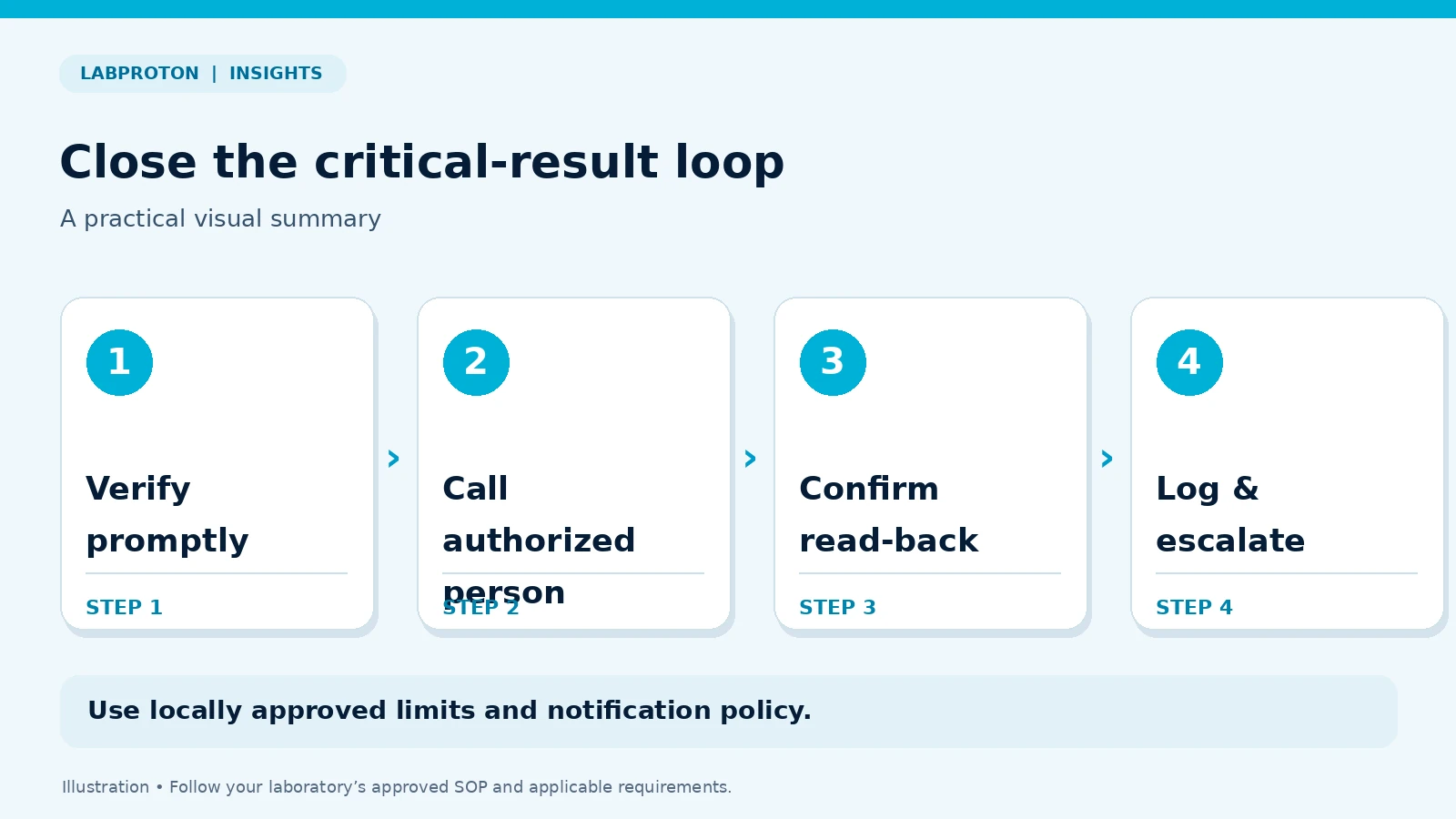
Before calling, confirm that the patient and specimen identifiers match, the relevant analytical quality controls were acceptable, and the result is not obviously affected by a known sample or instrument problem. Follow validated procedures for critical results, including any required rerun, dilution, or confirmation.
Do not automatically repeat every critical result. Repeat testing can delay notification and may be unnecessary for some reliable methods. If identity or analytical validity is genuinely in doubt, follow the approved escalation and verification process without allowing an avoidable delay; when appropriate, alert clinical staff that an urgent result is under verification according to local policy. When the specimen itself appears unsafe or mislabeled, do not solve the problem by issuing an unverified critical number.
Use a structured notification script
The person making the call should introduce the laboratory, identify the intended recipient, and convey the correct patient identifiers, test, value, units, and collection context as required by policy. Ask the receiver to read back or confirm the information using the approved closed-loop process. Do not leave sensitive results on an unverified voicemail or disclose them to someone without authorization.
A useful example is: 'This is the laboratory calling with an urgent potassium result for [verified patient identifiers]. The result is [value] mmol/L. Please read back the patient and result.' Real values must only be communicated using the actual authorized record.
Record the entire communication
Document the event immediately: patient and test identifiers, result and units, first notification attempt, successful contact time, recipient name and role, person making the call, read-back confirmation, and any escalation. If the provider could not be reached, record each attempt and the next contact route. A free-text note that says 'doctor informed' is rarely enough for reliable reconstruction.
When a result is corrected or amended after notification, determine who must be contacted again and document the follow-up. Communicating an incorrect critical value can be as hazardous as failing to communicate one.
Audit the process, not only the final timestamp
Review a small sample of critical-result events each month. Check whether the call met the locally defined target, whether the receiver was authorized, whether read-back was documented, and whether escalations were completed. Investigate system problems such as outdated phone numbers, confusing call lists, or a missing handoff between shifts.
A simple measure is the percentage of critical results communicated within the laboratory's defined time goal. Report the numerator and denominator clearly and investigate delays without assuming that one arbitrary time limit fits every setting.
A practical drill
Run a supervised exercise using a fictitious critical result. Ask the staff member to find the list, verify the case, choose the contact, complete read-back, and document the event. Then simulate an unanswered phone. If the team has to improvise the escalation, the policy needs work.
A good critical-result procedure turns a time-sensitive event into a predictable series of safe actions.
Example: an urgent result when the clinic is closed
Consider a fictional outpatient whose result reaches the laboratory's approved critical range after normal clinic hours. The technologist promptly checks the specimen identity, relevant analytical information, and policy for confirmation, then calls the designated contact. There is no answer. The procedure should not leave the result in a general voicemail and assume the clinical team will see it in the morning. The technologist follows the approved on-call escalation route, recording each attempt and the outcome.
Once an authorized recipient answers, the technologist states the patient identifiers and the exact result with units. The recipient confirms the information using the laboratory's required closed-loop or read-back process. The record includes the initial attempt time, successful contact time, identity of the recipient, and who completed the notification. If the result is later amended, the lab considers a new notification under its correction policy.
Avoid: treating software alerts as proof that a clinician has received the result, copying universal critical thresholds from an online chart, or automatically repeating every critical value while contact is delayed. The local protocol must be both urgent and safe.
Common questions
Do all critical results need automatic repeat testing?
No. The laboratory should follow its validated procedure. Unnecessary repeats can delay urgent communication, while legitimate identification or analytical concerns must be addressed promptly and safely.
What if the clinician cannot be reached?
Use the documented escalation route, record attempts and times, and continue until an authorized recipient is reached according to policy. Do not treat an unanswered call or informal voicemail as a completed notification.
Reference leads
ISO 15189:2022 requirements on reporting and communication; CLSI guidance on critical-risk result communication; applicable local patient-safety and privacy requirements.

Laboratory Software Security: Access, Backups, and Audit Trails
Protect laboratory records through role-based access, secure devices, verified backups, meaningful audit logs, and response planning.
Read article →
Daily Laboratory QC: A Step-by-Step Bench Routine
A practical daily QC workflow: check materials, apply approved acceptance rules, investigate failures, and document decisions.
Read article →
Levey–Jennings Charts and Westgard Rules, Explained
Learn how to read Levey–Jennings charts, interpret common Westgard QC signals, and investigate out-of-control results responsibly.
Read article →