How to Train and Keep a Strong Laboratory Team
Build a stronger laboratory team with structured onboarding, competency checks, safer workflows, cross-training, and useful staff feedback.

A laboratory depends on people who can recognize a questionable specimen, notice an unusual quality-control pattern, and explain a result without guessing. Equipment matters, but reliable testing also depends on training, safe staffing, and employees who feel comfortable reporting problems.
When experienced staff leave, a manager loses more than a name on the shift schedule. Knowledge of instrument quirks, sample handling, referral procedures, and local workflows can disappear with them. Recruiting replacements takes effort; poor onboarding can create new errors. The most practical response is to make training and retention part of everyday quality management.
Start with a clear role and a realistic first week
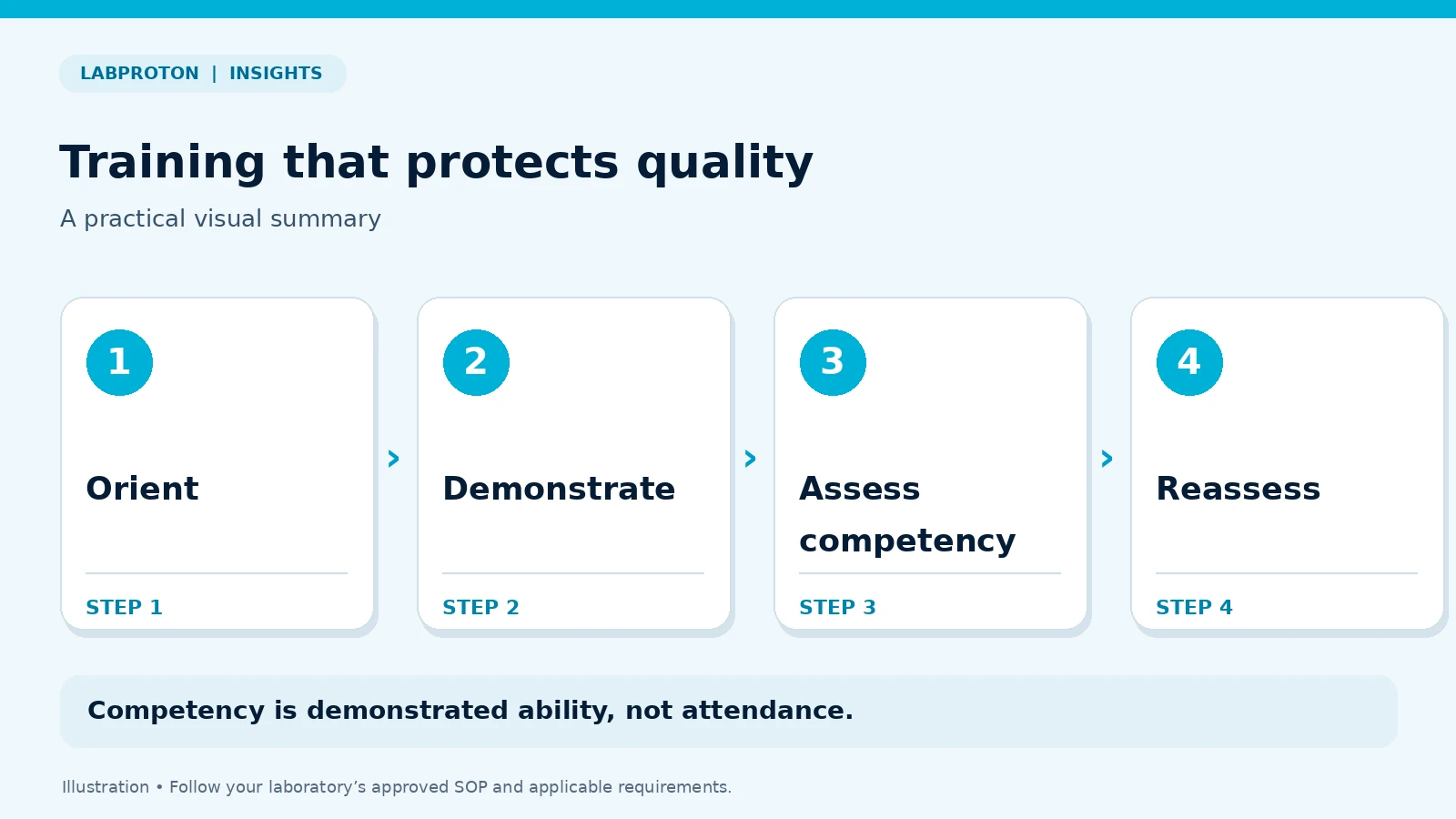
A new employee should know which tasks are authorized, who supervises them, and which steps they must not perform alone. Provide an orientation checklist covering specimen identification, safety, confidentiality, relevant procedures, instrument basics, quality control, incident reporting, and escalation. Avoid assuming that a person who previously worked on a similar analyzer already knows your laboratory's particular procedure.
Show each workflow, let the trainee practise with appropriate supervision, and observe their performance. Competency is demonstrated ability—not merely attendance at a lecture or signing that an SOP was read. Record the date, assessment method, findings, and authorization to work independently. Repeat assessments at intervals and after material changes as required by the applicable laboratory quality program; a signed training checklist alone is not proof of continued competence.
Build training around tasks, not job titles alone
A useful training matrix lists essential tasks in rows and staff members in columns. Mark whether each person is untrained, training, assessed as competent, or due for reassessment. This makes shift planning clearer and shows which critical tasks depend on only one person.
Cross-training can reduce disruption during absences, but it must be deliberate. Someone trained in chemistry cannot automatically cover blood banking, microbiology, or another high-risk area without meeting the relevant competence and authorization requirements. Prioritize tasks where the laboratory has few trained backups, and provide protected time for practice rather than squeezing everything into the busiest shift.
Protect staff from constant interruptions
A surprising amount of stress comes from poor workflow design: missing supplies, repeated phone calls during result entry, unclear priorities, and last-minute schedule changes. Observe a normal busy morning and ask staff which tasks cause unnecessary rework. Small fixes—such as a dedicated place for incoming samples, clearer handoff notes, or planned cover for meal breaks—can improve safety and morale.
Consider ergonomics too. Bench height, screen position, pipetting posture, and prolonged standing all deserve attention. A rotating task assignment may help with repetitive activity, provided all assigned staff are competent and the rotation does not introduce extra handoff risk.
Make feedback useful and psychologically safe
If staff believe they will be blamed for every near miss, they may stop reporting problems. Managers should distinguish honest mistakes, risky systems, and deliberate disregard of clear safety rules. Investigate what made an error possible: an ambiguous label, missing training, a confusing screen, or an overloaded workstation.
Hold short, regular team conversations. Ask what nearly went wrong, what delayed results, and which change would help the next shift. Close the loop: tell staff whether an idea was tried and what happened. A suggestion box that never leads to action quickly becomes meaningless.
Give people a reason to grow
Not every skilled technologist wants to become a manager. Offer paths such as QC coordination, internal auditing, training new colleagues, safety oversight, or validation projects. Support relevant continuing education when possible and make promotion or pay decisions transparent. Recognize careful work—not simply the number of samples processed.
A useful retention conversation asks three questions: What makes your day harder than it should be? Which skill would you like to develop next? What would help you do your work safely and confidently? Responses matter only if the laboratory acts on them.
Measure what matters
Track training completion, competency reassessment, vacancies, unplanned overtime, and turnover. Review them alongside QC events, turnaround delays, and reported near misses, while remembering that correlation does not prove causation. In a small laboratory, protect individual privacy when discussing trends.
The goal is not a perfect staff roster. It is a team with clear responsibilities, dependable backup coverage, and enough support to notice problems early rather than work around them silently.
Example: training a new staff member on specimen intake
A new accessioning employee may understand the software after a short demonstration but still need training on identity discrepancies and specimen exceptions. A practical plan begins with observation: the trainer shows how to match patient identifiers, check the request, place labels on the correct container, and hold uncertain specimens. Next, the employee practises with supervised samples and simulated mismatches. The assessor then watches the employee handle ordinary and exception cases without prompting, using the laboratory's approved competency method.
The staff member's training record should state which tasks were assessed, how competence was evaluated, and what limitations remain. If the employee is permitted to receive routine tubes but not authorize exceptions, that boundary must be clear to everyone. A future reassessment can focus on areas where mistakes have occurred or procedures changed.
Avoid: marking a whole department as 'trained' after one orientation session, assuming seniority proves competence in a different method, or treating every reported near miss as personal failure. Training works best when staff feel able to ask for help before a decision becomes irreversible.
Common questions
How is competency different from training?
Training explains or demonstrates a task; competency assessment checks that a person can perform it correctly under defined conditions. The laboratory should use suitable assessment methods and retain records before assigning independent work.
Should every employee rotate through every department?
No. Cross-training is useful only when it matches qualifications, competency requirements, workload, and patient-safety needs. A short assignment in another section does not authorize independent performance of unfamiliar or regulated testing.
Reference leads
WHO, *Laboratory Quality Management System: Handbook* (2011), personnel chapter; applicable CLSI training and competence-assessment guidance; local occupational safety requirements.

Daily Laboratory QC: A Step-by-Step Bench Routine
A practical daily QC workflow: check materials, apply approved acceptance rules, investigate failures, and document decisions.
Read article →
Specimen Accessioning and Labeling: Five Safe Steps
Follow five practical steps to match specimens and orders, check containers, apply barcodes, and document intake exceptions.
Read article →
How to Reduce Avoidable Specimen Rejections
Reduce avoidable specimen rejections with clear acceptance criteria, consistent rejection-rate tracking, and targeted collection improvements.
Read article →