How to Reduce Avoidable Specimen Rejections
Reduce avoidable specimen rejections with clear acceptance criteria, consistent rejection-rate tracking, and targeted collection improvements.

A rejected specimen creates more work for the laboratory and often means the patient must be contacted for another collection. Sometimes rejection is the safest decision: testing an incorrectly identified or unsuitable sample could produce a misleading result. The aim is not to make rejection numbers look artificially low. It is to prevent avoidable collection and handling problems while consistently applying appropriate acceptance criteria.
Specimen rejection is only one part of pre-analytical quality. Published estimates of the proportion of all laboratory errors occurring before analysis should not be confused with an individual laboratory's rejection rate. Use your own data to understand how often specimens are rejected and why.
Define clear, test-specific acceptance rules
Your specimen acceptance and rejection procedure should explain how staff handle missing or conflicting identifiers, incorrect containers or additives, clots in anticoagulated specimens, insufficient volume, leakage, transport delays, inappropriate temperatures, and suspected interference. Rejection decisions must not compromise identification safeguards simply to avoid recollection. Criteria can vary by analyte, method, and sample type.
Hemolysis, icterus, and lipemia do not make every test automatically invalid. Their effect depends on the assay and degree of interference. Visual appearance may help identify a problem, but it cannot replace validated instrument indices or method-specific thresholds where those are available. For many tests, hemolysis becomes apparent only after serum or plasma separation.
Separate identity errors from quality problems
An unlabeled or mismatched specimen can pose a different and more serious risk than a mildly hemolyzed sample. Follow the laboratory's written identification and exception policy. Never relabel an uncertain specimen simply because someone thinks they remember who it belongs to. Special handling of irreplaceable specimens, if permitted, requires documented clinical authorization and local procedures.
For other problems, document whether the specimen was rejected, tested with a stated limitation, or held for clarification under an approved procedure. Record the affected assay rather than assuming the entire panel must always be discarded.
Measure a consistent rejection rate
A basic indicator is:
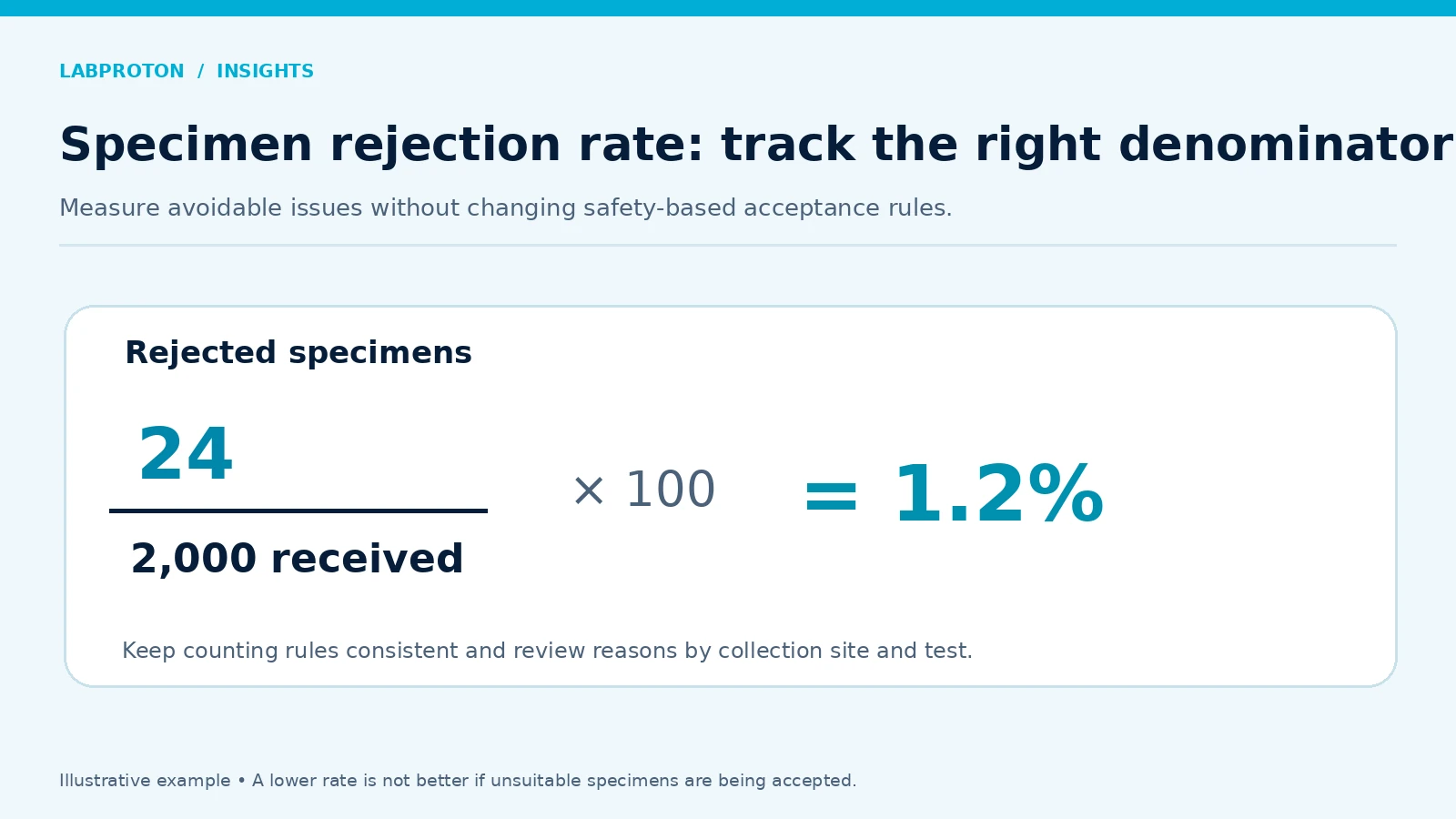
Specimen rejection rate (%) = rejected specimens / specimens received × 100
Define exactly what counts as a 'specimen' in the numerator and denominator, and keep that definition stable. Count reasons separately: clotted EDTA, wrong tube, short draw, identification mismatch, transport delay, and so on. A monthly overall rate is useful, but the list of reasons tells you what to fix.
For example, if a laboratory receives 2,000 specimens and rejects 24, the rejection rate is 1.2%. That number alone does not show whether the problem is concentrated in one collection site, assay, or shift. Compare like with like and use sufficiently large sample counts before drawing conclusions.
Fix the process closest to the problem
If clotted EDTA samples are common, review collection technique, tube filling, and mixing requirements for that tube. If specimens arrive warm after long transport, examine packaging, pickup schedules, transport logs, and stability limits. If labels are frequently wrong, observe when identifiers are printed and attached, and whether staff have enough uninterrupted space to do it safely.
Avoid blaming people from a single month's figures. Visit the collection area, demonstrate the correct process, and listen for practical obstacles. Provide a short illustrated collection guide to external clinics if they repeatedly submit unsuitable tubes. Build feedback around patient safety, not punishment.
Create a traceable rejection workflow
At intake, check identifiers and visible container problems. During processing, check for issues that are only detectable later, including certain forms of interference. Document the rejection reason, affected tests, time, staff member, and notification. Use a laboratory log or suitable software feature that actually exists in your workflow; do not assume every LIMS automatically records or sends rejection notices.
When the reason is resolved, record the recollection or corrective action. Review trends regularly and confirm that education or workflow changes reduced the specific problem without creating a new one.
Start with one improvement: choose your most frequent preventable rejection reason, review ten cases, observe the related workflow, and test one change for a month. That is more useful than a generic lecture telling everyone to 'be more careful.'
Example: a clotted EDTA problem
A laboratory notices that clotted EDTA samples account for many recent recollection requests. The manager begins by confirming that the rejection reason is being recorded consistently, then checks whether the affected specimens come from a particular shift, collection location, or tube type. The pattern may suggest insufficient mixing immediately after collection, but a cause should not be assumed without observing the workflow and reviewing the manufacturer's instructions.
During a supervised visit, staff demonstrate how tubes are collected, filled, and mixed. The team identifies a practical problem: the rack is too far from the chair, and tubes are being set aside while multiple patients are processed. Moving the rack and reinforcing the proper collection sequence may be a reasonable first change. The next month's rate of clotted EDTA rejection—with the same denominator and counting rules—can show whether that specific problem improved.
Avoid: lowering rejection criteria simply to improve statistics, relabeling uncertain tubes, blaming a clinic without an investigation, or assuming that every visibly discolored sample needs the same decision. Patient identification and method-specific acceptance come first.
Common questions
Is a low rejection rate always good?
Not automatically. A rate can fall if staff stop documenting problems or accept unsuitable samples. Pair rejection counts with audits of identification, specimen integrity, and patient-impact events.
Can every hemolyzed tube be rejected at reception?
No. Hemolysis is often assessed after serum or plasma separation, and its effect is method-specific. Apply validated interference criteria to the affected assays and follow the laboratory acceptance policy.
Reference leads
WHO, *Laboratory Quality Management System: Handbook* (2011); current CLSI guidance on specimen collection, labeling, and handling; the manufacturer's assay-specific interference information.

Specimen Accessioning and Labeling: Five Safe Steps
Follow five practical steps to match specimens and orders, check containers, apply barcodes, and document intake exceptions.
Read article →
Hemolysis, Icterus, and Lipemia: What Labs Should Check
Understand hemolysis, icterus, and lipemia and why laboratories need assay-specific interference limits before reporting results.
Read article →
Laboratory Inventory: Reduce Waste Without Running Out
Reduce reagent waste with FEFO rotation, realistic reorder points, traceable stock records, and a simple monthly inventory review.
Read article →