Hemolysis, Icterus, and Lipemia: What Labs Should Check
Understand hemolysis, icterus, and lipemia and why laboratories need assay-specific interference limits before reporting results.

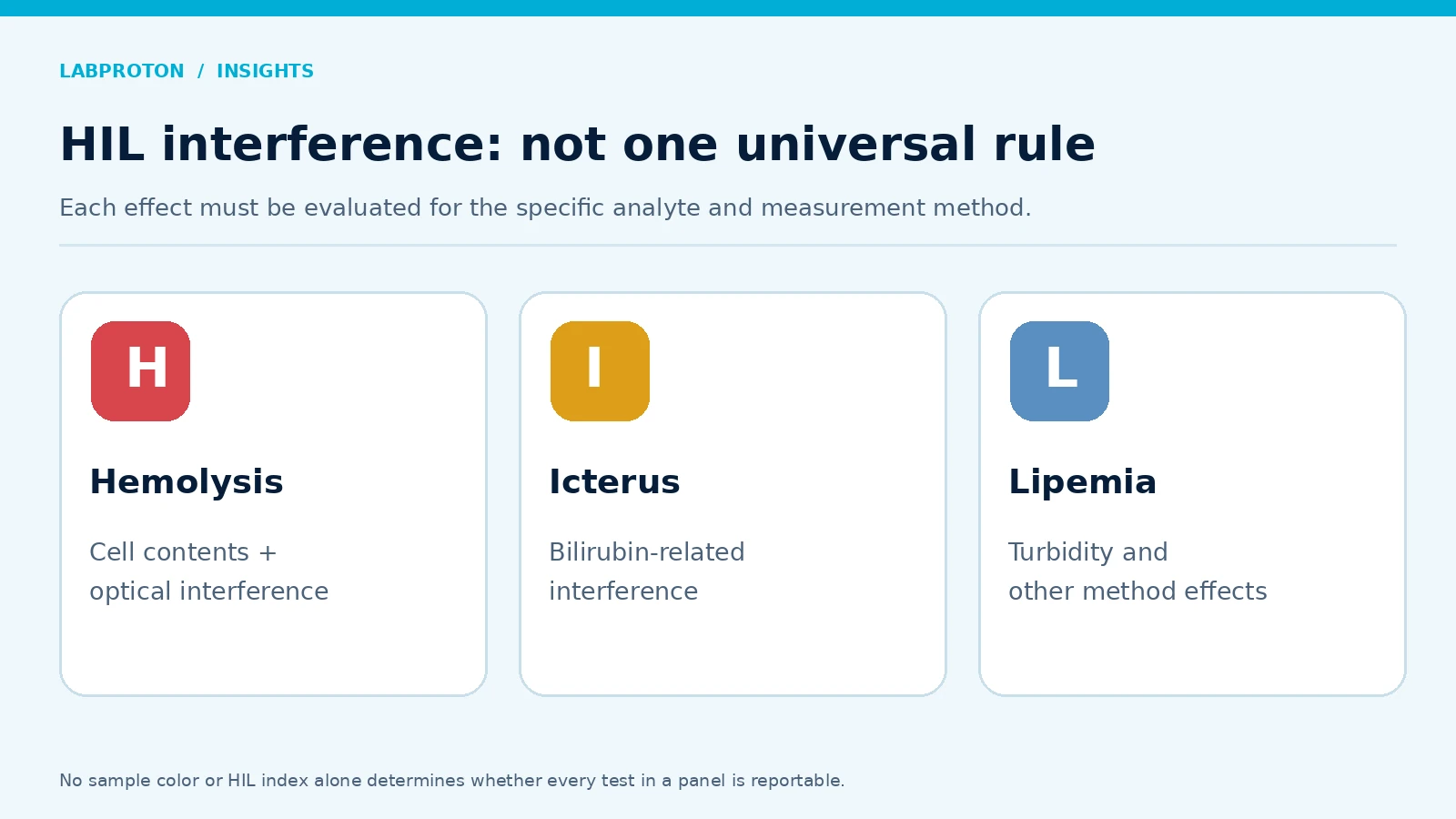
Hemolysis, icterus, and lipemia—often abbreviated HIL—are common reasons a serum or plasma sample may be unsuitable for certain laboratory measurements. They do not have identical effects, and they do not interfere with every assay in the same way. The safest approach is to assess the sample using the method's validated interference limits rather than reject it solely because it looks unusual.
Interference can cause results to be falsely high, falsely low, or unreliable. It can also go unnoticed if staff assume that a normal-looking sample is automatically acceptable.
Hemolysis: more than a red sample
Hemolysis releases intracellular components from red blood cells into serum or plasma. It can affect some analytes through the added cell contents or by interfering with the measurement signal. For example, in-vitro hemolysis often causes a falsely increased potassium concentration because red-cell contents enter the sample. Other analytes may be affected differently, and the magnitude and reporting decision still depend on the specimen and method. Not all visual redness represents the same concentration of free hemoglobin.
Collecting technique, needle and device selection, mixing, difficult draws, and specimen transport can all contribute. When a sample is hemolyzed, look up the assay-specific criteria. Do not report a potentially misleading result just because another analyte in the same tube remains measurable.
Icterus: bilirubin and method dependence
Icteric samples contain increased bilirubin and may appear yellow or brown. Bilirubin can interfere with some chemical reactions or optical measurements, but no single bilirubin threshold applies to every test system. Laboratories using automated HIL indices should interpret them using the analyzer manufacturer's mapping to each affected assay and any locally verified criteria.
Do not confuse a clinical abnormality with an analytical error. A patient may genuinely have elevated bilirubin; that clinical finding should not be mistaken for a faulty specimen. The laboratory must separately decide whether the requested measurements are technically valid.
Lipemia: turbidity can change the signal
Lipemic samples may look cloudy or milky, often because of increased lipoprotein particles. Light scattering can affect photometric methods, and sample heterogeneity can complicate some techniques. Certain methods of measuring electrolytes may also be affected by substantial lipid or protein fractions; interpretation depends on whether the instrument uses direct or indirect ion-selective electrodes.
Not every lipemic sample needs to be discarded, and not every correction or sample treatment is appropriate. Ultracentrifugation, dilution, or alternative methods may be considered only when validated for the analyte and specimen, with any limitations documented.
Build a test-specific decision table
For each assay, record the manufacturer's relevant interference claim, the laboratory's applicable threshold, and what staff should do when the limit is exceeded. Possible decisions include reporting an unaffected analyte, withholding an affected result, requesting recollection, using a validated alternative measurement, or releasing a result with an approved comment when permitted. The action must be determined by the quality system, not guessed at the bench.
A useful table includes: assay | sample type | HIL threshold | action | reporting comment | responsible reviewer. Keep units and index conventions consistent with your instrument, because numerical HIL indices are not universally interchangeable between manufacturers.
Improve collection rather than only rejecting tubes
If hemolysis is increasing, review the collection locations and transport routes. For lipemic specimens, check test-specific preparation instructions and whether fasting is actually required; do not automatically order fasting for every lipid-related or chemistry test. Monitor how often samples are held, recollected, or reported with limitations.
If automated HIL data are available, record the relevant index and analyzer flags alongside the affected result. Never imply that a LIMS can calculate or detect an interference that the connected analytical method does not measure.
A simple review question
When looking at an abnormal specimen, ask: 'Which requested tests might be affected, by what mechanism, and what validated action does our laboratory use?' That question is far safer than labeling the whole tube 'bad.'
Example: an abnormal specimen with several ordered tests
Suppose a serum sample is visibly abnormal after separation and the chemistry analyzer reports an elevated H index. The clinician ordered potassium, glucose, and another chemistry assay. It would be unsafe to assume that all three tests must be rejected or that all three can be reported with a generic note. The laboratory checks the interference criteria for each assay on the actual platform, along with specimen identity and other quality information.
One measurement may exceed its validated limit while another remains within the acceptable range. Staff document the specific assays held or reported, the reason for each decision, and any notification or recollection action required. If an alternate measurement is proposed, it must be approved and validated for that use. The same process applies to icterus and lipemia, recognizing that the underlying mechanisms differ.
Avoid: relying on a sample's color alone, applying another manufacturer's index thresholds, and using 'report with comment' or 'cancel and recollect' as an automatic rule for every affected result. Accurate interpretation is analyte- and method-specific.
Common questions
Does an HIL flag make the whole panel invalid?
Not necessarily. Interference depends on the analyzer method, analyte, specimen, and index level. Some results may be reportable while specific measurements must be held or repeated using an approved approach.
Can I use the same HIL cutoff across different analyzers?
Not safely without validation. HIL scales, methods, and reporting rules differ across platforms. Follow the applicable manufacturer information on interference documentation and verified local procedure.
Reference leads
Current manufacturer's interference claims; relevant CLSI guidance on HIL indices and interference testing; WHO laboratory quality management guidance.

How to Reduce Avoidable Specimen Rejections
Reduce avoidable specimen rejections with clear acceptance criteria, consistent rejection-rate tracking, and targeted collection improvements.
Read article →
Specimen Accessioning and Labeling: Five Safe Steps
Follow five practical steps to match specimens and orders, check containers, apply barcodes, and document intake exceptions.
Read article →
Levey–Jennings Charts and Westgard Rules, Explained
Learn how to read Levey–Jennings charts, interpret common Westgard QC signals, and investigate out-of-control results responsibly.
Read article →