Laboratory Inventory: Reduce Waste Without Running Out
Reduce reagent waste with FEFO rotation, realistic reorder points, traceable stock records, and a simple monthly inventory review.

Running out of a reagent can delay patients. Buying too much can waste money when a kit expires before it is used. Laboratory inventory management is therefore a balance between availability, cost, storage conditions, and test quality—not simply keeping shelves full.
A reliable system does not need to be complicated. A small laboratory can start with a consistent stock record, clear ownership, and a few calculations based on actual consumption. The important part is recording what comes in, where it is stored, when it expires, and what gets used.
Know exactly what you have
Create a record for each item: name, supplier, catalogue or product code, lot number where relevant, quantity, unit of measure, expiry date, and storage location. For temperature-sensitive material, also record receipt condition and required storage range. Separate unopened kits from opened or reconstituted materials when their usable life differs.
Count in the same units every time. If one box contains ten reagent cartridges, do not alternate between recording 'one box' and 'ten cartridges' without a defined conversion. Track controls, calibrators, tips, printer rolls, and sample tubes as well as testing reagents; a missing low-cost item can still stop a workflow.
Rotate by expiry, not simply by purchase date
For expiration-controlled reagents, FEFO—first expiry, first out— is generally more useful than a blanket first-in, first-out (FIFO) rule. Put material with the earliest usable expiry where staff will select it first, provided it is approved for use and all lot-validation rules are satisfied. An older delivery may have a later expiry than a newer one.
Respect open-vial stability, reconstitution limits, storage instructions, and laboratory lot-change procedures. Do not swap lots mid-run merely because one expires sooner if the method requires verification, calibration, or controlled lot transitions.
Calculate a realistic reorder point
A reorder point is the stock level that triggers purchasing. A basic starting model is:
Reorder point = expected use during supplier lead time + safety stock
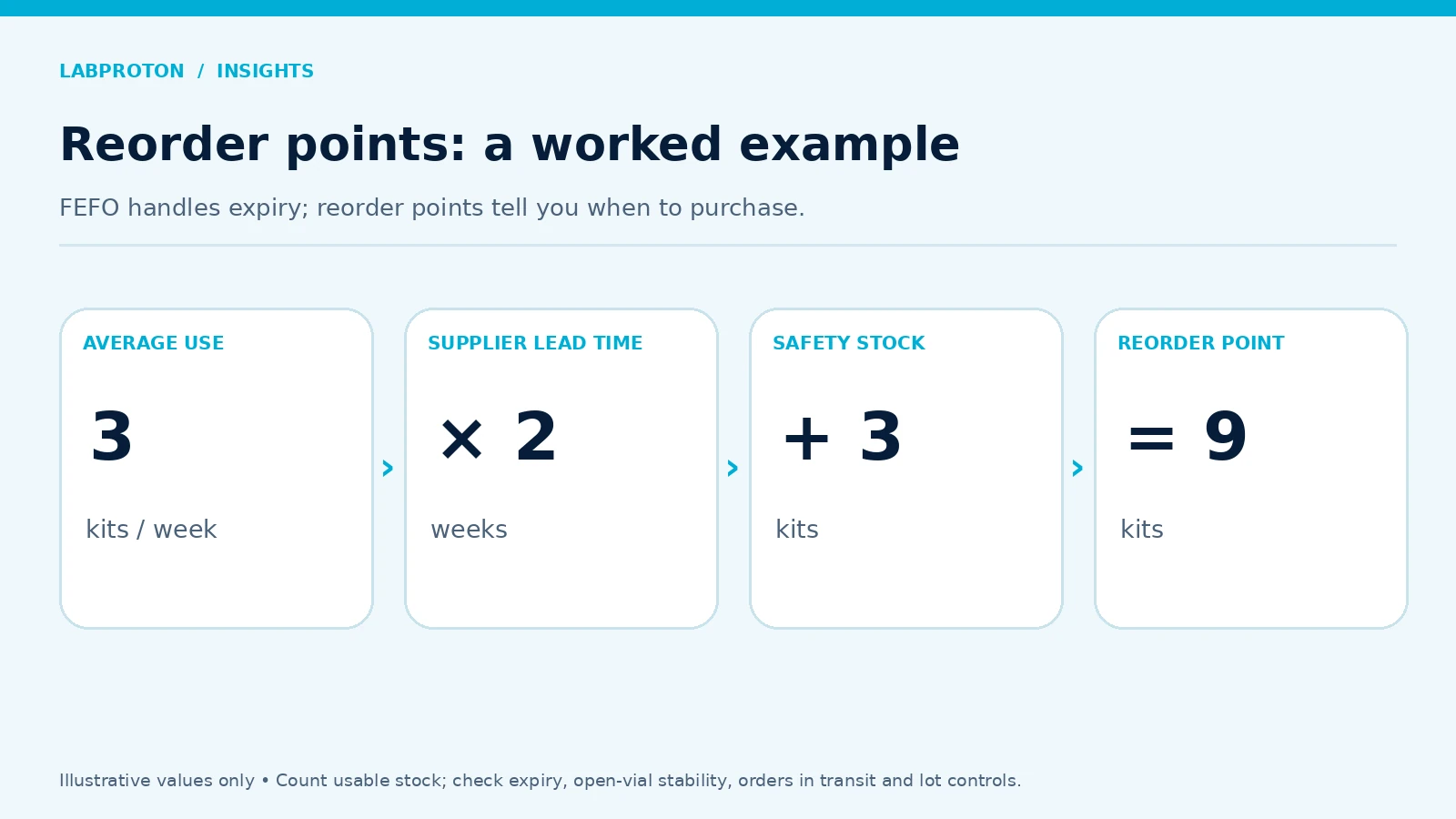
Suppose a laboratory uses 12 glucose reagent kits per month, equivalent to about three per week, and delivery typically takes two weeks. Expected demand during lead time is roughly six kits. If the lab keeps a buffer of three, it could set a reorder point near nine kits. This is an illustrative example, not a recommendation for every product. Demand variation, minimum order sizes, shipment interruptions, and expiry risk all change the right number.
A target/par level is different: it describes the desired quantity after replenishment or a practical operating level. Do not set the target so high that material expires before it can be used. For multi-assay panels, calculate supplies per assay rather than assuming that one panel consumes one reagent test.
Record movement and watch waste
When stock arrives, check the item, quantity, lot, expiry, packaging, and temperature conditions before releasing it to storage. Log transfers, issues to the bench, returns, damage, expiry, and disposal. A barcode scanner can help, but a scanner does not replace a reliable stock process.
Review expired-value losses and urgent orders monthly. Ask whether waste came from inaccurate demand estimates, excessive safety stock, poor shelf rotation, unstable delivery, or a large minimum order. If an item frequently expires unused, reduce the order quantity or negotiate smaller, more frequent deliveries.
Work with suppliers, not against them
For frequently used materials, discuss lead times, delivery days, minimum quantities, and lot availability. Standing orders may be useful, but only when demand is predictable and contracts allow adjustments. Plan for interruptions without storing so much that the backup stock expires. For critical single-source materials, document what the lab will do if a delivery is delayed.
A simple monthly inventory review
Pick ten high-value or high-risk items. For each, compare recorded stock with a physical count, review the nearest expiry, estimate expected consumption, and confirm the reorder point. Investigate differences rather than adjusting them silently. Make one person responsible for reviewing the record, while allowing authorized staff to log stock movements.
Good inventory control gives technicians what they need when they need it, while making costs and waste visible to management.
Example: choosing a reorder point without filling the storeroom
Suppose a laboratory uses approximately three kits of a particular reagent each week. Delivery typically takes two weeks, so average demand during lead time is six kits. After reviewing delays and workload fluctuations, the manager sets aside three additional kits as safety stock. The resulting illustrative reorder point is nine kits. That means the laboratory should begin its approved purchasing process when the stock position approaches nine kits—not automatically buy nine more kits. Stock position ordinarily accounts for usable stock on hand, confirmed stock already on order, and outstanding demand; do not treat undelivered purchases as material available at the bench.
To decide the order quantity, compare the intended target stock with existing usable kits, outstanding deliveries, minimum-order conditions, and expected expiry. If the intended purchase would leave five weeks of supply but the available lot expires in three weeks, the excess risks waste. Adjust quantity for existing stock, delivery timing, and any different open-kit stability limits. An opened kit may have a much shorter usable period than its printed expiry date, and different assays within a panel may consume supplies at different rates.
Avoid: counting expired or quarantined stock as available, overlooking lot-change verification, using the same unit label for boxes and tests, or automatically reordering based on last month's highest demand. Review the calculation when delivery or workload changes.
Common questions
Why not use FIFO for every reagent?
First-in, first-out tracks receipt order, but the first kit received may not be the first to expire. FEFO prioritizes the earliest usable expiry, subject to lot-control and stability requirements.
How often should a small lab count its stock?
Choose a schedule based on risk and value. Critical short-supply reagents may deserve frequent checks; stable low-value consumables can be checked less often. Physical counts should regularly reconcile with records, especially before ordering.
Reference leads
WHO, *Laboratory Quality Management System: Handbook* (2011), purchasing and inventory; applicable manufacturer instructions and laboratory quality procedures.

Choosing Reliable Lab Computers, Scanners, and Backups
Choose dependable laboratory computers, barcode scanners, printers, UPS equipment, and testable backup and restore procedures.
Read article →
Find and Fix Laboratory Workflow Bottlenecks
Find laboratory delays by tracking handoffs, measuring waiting time, testing one fix, and checking quality alongside speed.
Read article →
How to Reduce Avoidable Specimen Rejections
Reduce avoidable specimen rejections with clear acceptance criteria, consistent rejection-rate tracking, and targeted collection improvements.
Read article →