How to Learn More From EQA and Proficiency Testing
Use proficiency testing and EQA results to find reporting errors, understand peer comparisons, and improve laboratory procedures.

Internal quality control checks whether an analytical system is behaving consistently within the laboratory. External quality assessment (EQA) or proficiency testing (PT) compares performance with an external program using unknown or blinded materials. Together, they provide different views of quality. Neither can by itself prove that every patient result is correct.
An EQA report should be treated as information for improvement, not merely a certificate to file away. Its value comes from understanding what was assessed, how the score was calculated, and what the laboratory does when results differ.
Understand what the scheme measures
EQA providers distribute specimens or test challenges and evaluate reported results according to the program design. Some scores are based on assigned reference values; others use a method-specific peer group. Programs may report percent difference, z-score, SDI, qualitative agreement, or other measures. Compare like methods and use the grading criteria actually supplied by your provider.
Avoid claiming that all providers compare thousands of laboratories or that all PT results can be interpreted with the same SDI cutoffs. The number of participants, type of material, commutability, and evaluation statistics vary. An SDI or similar difference score of zero does not mean 'perfect clinical accuracy'; it means agreement with the selected comparison value under that calculation. Method-specific peer values are not automatically traceable reference values.
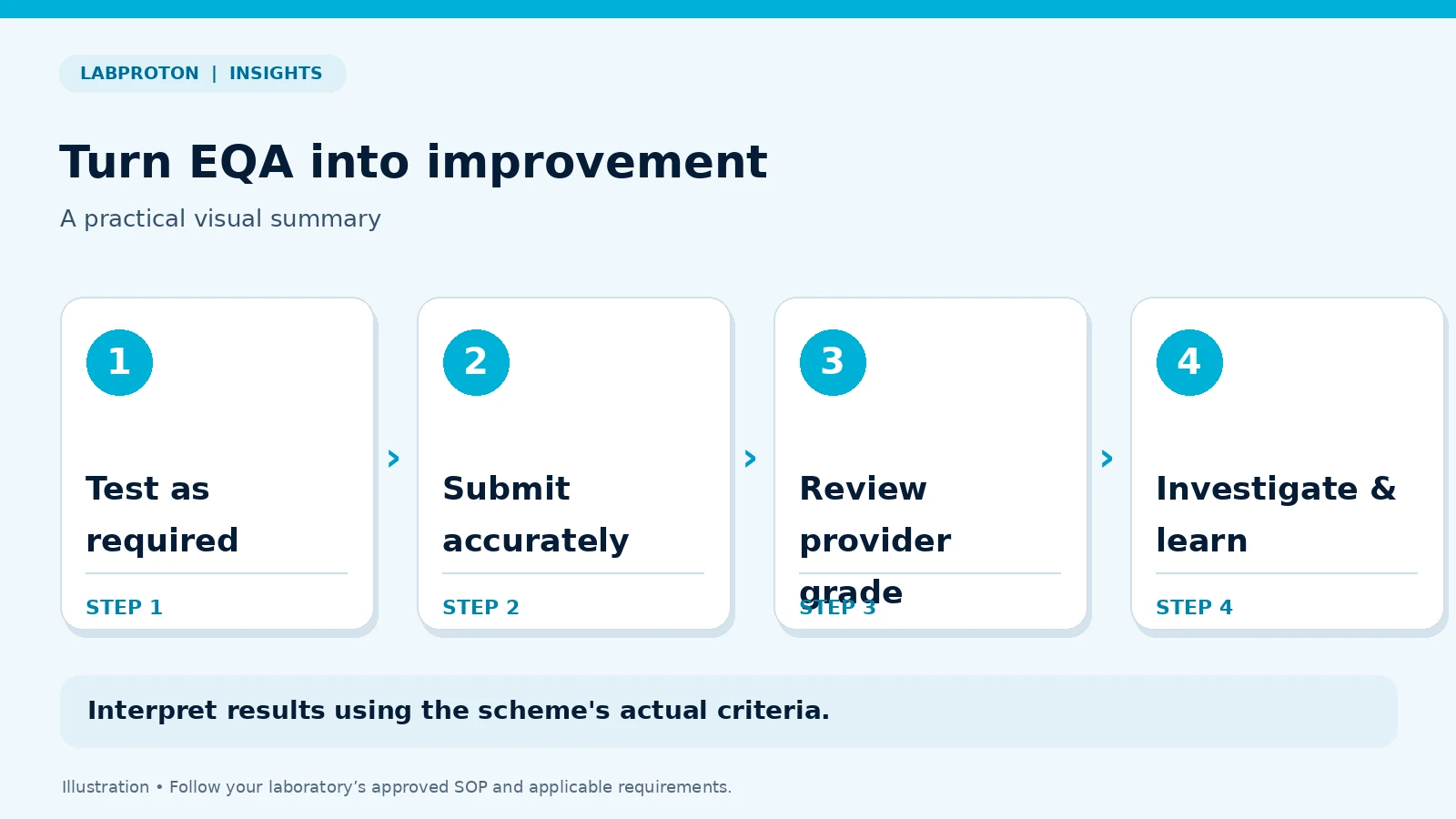
Test the material according to program rules
Follow the provider's instructions and applicable regulations. Many regulated programs require PT samples to be handled in the routine patient-testing workflow and prohibit inappropriate extra testing or communication with other participants before the deadline. In the United States, specific CLIA PT requirements can apply. Do not generalize every local requirement to all countries and programs.
Assign the work to staff authorized for the method, record the date, control and instrument status, and submit the correct units and identifiers. A technically good measurement can be graded as a failure if it is reported under the wrong analyte, unit, or sample number.
Review good results as well as poor ones
After receiving the report, check every analyte against the program's official criteria. Look for persistent positive or negative differences across events, even if individual results were accepted. A borderline result may be worth monitoring, but do not automatically equate an elevated SDI with a regulatory failure.
For qualitative tests, review whether the positive/negative agreement met the program definition. For quantitative methods, investigate trends at different concentrations, including whether a problem occurs only near a clinical decision point.
Respond to an unsatisfactory outcome systematically
First confirm the basics: correct sample, entered value, units, analyte code, instrument, method group, and submission deadline. Then review the analytical record, reagent and calibrator lots, QC performance, maintenance, method changes, and any reported specimen-handling issue. Identify the likely cause before choosing corrective action.
For example, a glucose result submitted in mmol/L when the EQA form expected mg/dL is a reporting error, not evidence of instrument bias. A result consistently higher than the method-group target across several rounds may warrant a technical investigation. The two problems need different solutions.
When required, document the nonconformity, assessment of patient impact, corrective action, responsible person, and effectiveness check. Follow local requirements for any restriction or suspension of affected patient testing; do not claim every single EQA failure universally requires a complete shutdown.
Turn the event into learning
Discuss de-identified findings at a team meeting. Update training or procedures if the investigation shows a gap. Track recurring issues by method or stage—preparation, analysis, data transcription, or submission. If a provider or peer-group issue is suspected, contact the scheme for clarification and retain its response.
A five-question EQA review
What value was assigned? How was acceptability decided? Were our method and units grouped correctly? Does the trend agree with our internal QC and method verification? What change, if any, should we make—and how will we know it worked?
EQA helps laboratories look beyond their own walls. The strongest program turns each result into a better-understood testing process.
Example: an EQA result that looks like an analyzer failure
A laboratory receives a poor external assessment result for a chemistry analyte. Before recalibrating the instrument, the quality supervisor compares the submitted value, analyte code, units, method grouping, and official evaluation report. The recorded instrument result was correct, but the submission form used a different unit. The problem is clerical and may require correction of the reporting workflow, rather than maintenance of a functioning analyzer.
In another event, a laboratory repeatedly reports values on the same side of its method-group target across several rounds. This may warrant deeper investigation of calibration, traceability, reagent lots, analytical methods, and the comparison group's suitability. Neither observation should be interpreted from SDI alone without the scheme's actual grading rules.
Avoid: applying fixed SDI pass/fail thresholds that the provider did not specify, treating a peer mean as perfect truth, or handling PT samples in ways the provider or regulations prohibit. The best outcome of EQA is a better-understood process—not simply a passing certificate.
Common questions
Is SDI the same as a pass/fail grade?
No. It is one possible comparison measure. Providers can use different methods and acceptance limits, and their official grading criteria determine whether an EQA event was acceptable.
Should I retest an EQA sample to improve the score?
Follow the program instructions and legal requirements. Special extra testing or communication can be restricted in regulated PT. Investigate any deviation through normal quality procedures, without changing the official result to make it look better.
Reference leads
WHO, *Laboratory Quality Management System: Handbook* (2011); current EQA scheme instructions; applicable national PT regulations; current CLSI guidance on EQA/PT.

Daily Laboratory QC: A Step-by-Step Bench Routine
A practical daily QC workflow: check materials, apply approved acceptance rules, investigate failures, and document decisions.
Read article →
Levey–Jennings Charts and Westgard Rules, Explained
Learn how to read Levey–Jennings charts, interpret common Westgard QC signals, and investigate out-of-control results responsibly.
Read article →
Hemolysis, Icterus, and Lipemia: What Labs Should Check
Understand hemolysis, icterus, and lipemia and why laboratories need assay-specific interference limits before reporting results.
Read article →