Specimen Storage and Retrieval: A Practical Guide
Improve specimen storage and retrieval with clear location records, stability checks, chain of custody, and controlled disposal.

A specimen may still be needed after the initial report is issued. A clinician might request an add-on test, the laboratory may need to investigate a result, or a retention policy may require the sample to remain available for a defined period. If tubes are stored wherever there is space, finding the correct one can become slow and unsafe.
An effective retention process has three parts: suitable storage, traceable location, and controlled disposal. None of these is solved by a refrigerator alone.
Know which samples are worth keeping
Start with the clinical and regulatory requirements that apply to each specimen and test. Retention periods vary by specimen type, analyte, jurisdiction, and intended use. A sample may have a required administrative retention period but be analytically unsuitable for a later add-on test; these are different questions.
Do not publish a single universal number of days for all chemistry, hematology, or microbiology specimens. Use the applicable stability data, laboratory validation, biosafety practices, and retention policy. Record when a sample becomes ineligible for additional testing even if it has not yet been discarded.
Design storage locations that can be described precisely
Use a simple hierarchy such as refrigerator → shelf → rack → position. Each location should have a unique identifier that staff can record without ambiguity. Separate specimens by conditions and risks: ambient, refrigerated, frozen, protected from light, special biohazard handling, or restricted access where appropriate.
Do not store samples based only on tube-cap color; similar colors can have different contents and requirements. Avoid overcrowding that prevents air circulation or makes temperature monitoring unreliable. Keep retention and disposal areas clearly distinguished, and record any transfer into or out of controlled storage so the location remains trustworthy.
Record the chain of custody
At minimum, a retention log should connect specimen identifier, patient or visit reference as permitted, sample type, storage location, date/time placed into storage, expected review or disposal date, and relevant conditions. Include who moves a tube and when if the laboratory needs retrieval traceability.
An organized paper log can work in a small laboratory, as can appropriate software. The key is that the physical location matches the record. A barcode helps only when the tube is scanned at each meaningful transfer.
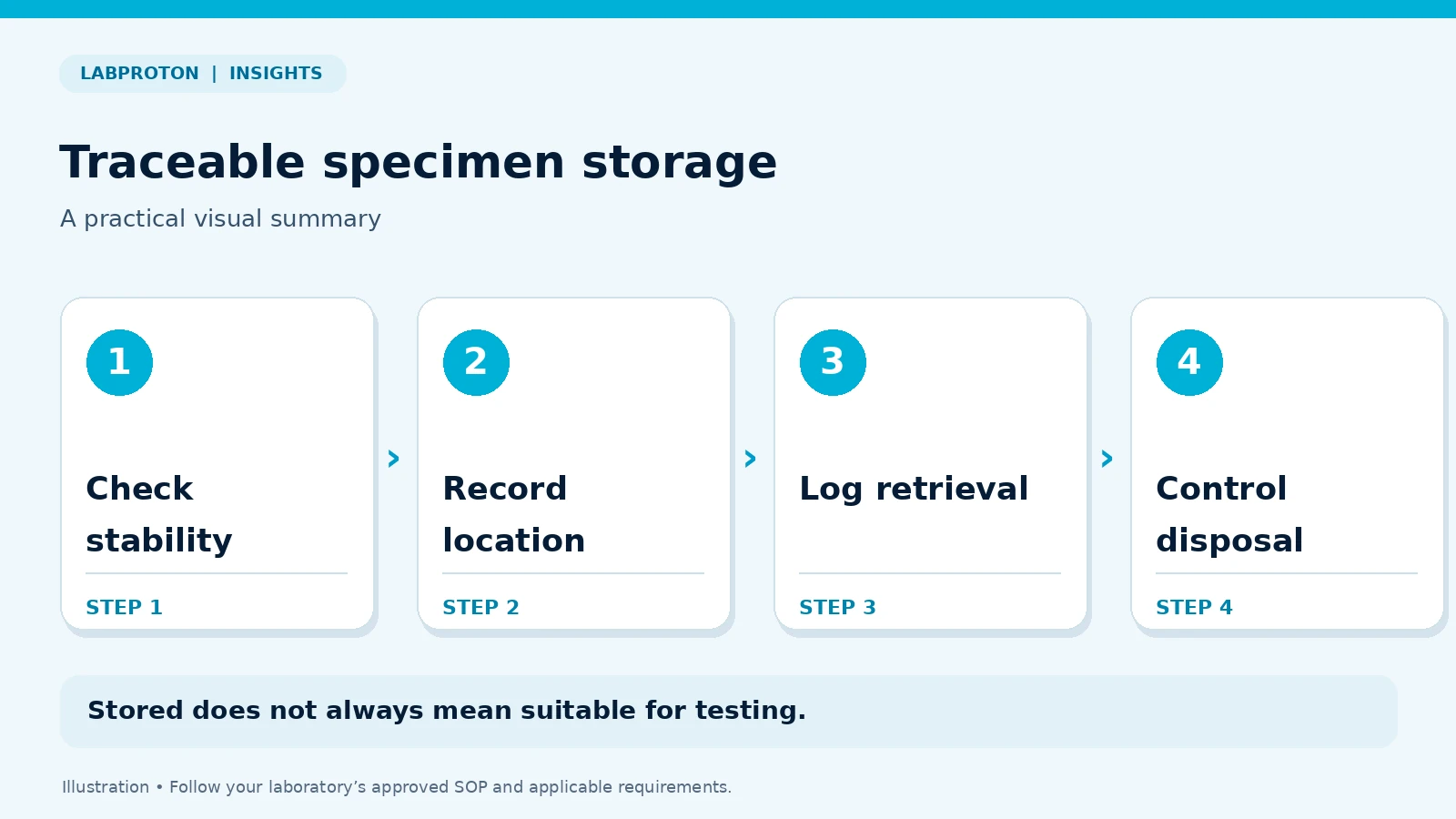
Check stability before an add-on test
When an add-on request arrives, verify that the requested analyte is suitable for the specimen type, age, storage condition, and remaining volume. Consider separation timing, anticoagulant, freeze–thaw history, evaporation, contamination risk, and the manufacturer's or validated stability claims. Some assays require a new collection regardless of how neatly the original tube was stored.
If the specimen is unsuitable, explain the limitation and request recollection or another approved action. Do not accept a result solely because the tube is physically present.
Make retrieval a controlled workflow
Locate the exact tube using the storage record, confirm the identifier, log retrieval, and note whether the specimen will be returned, consumed, referred, or disposed of. Keep time outside required storage conditions as short as the procedure requires. If the tube is returned, update the location and condition record.
Test the system with a simulated retrieval: ask someone unfamiliar with the storage arrangement to locate a de-identified specimen using only the recorded location. If they cannot find it quickly and safely, the record or labeling scheme needs improvement.
Dispose of specimens safely and on schedule
Set a regular review for material that has reached its retention limit, subject to holds, investigations, or legal requirements. Segregate and discard according to local biohazard and privacy rules. Record relevant disposal events and prevent a specimen under investigation from being discarded automatically.
A brief scheduled storage check
Confirm refrigerator/freezer temperature records, inspect the oldest retention rack, spot-check several locations against the log, identify nearing-expiry samples, and ensure that discarded material has been documented. Small reviews prevent months of hidden disorder.
The goal is simple: when someone asks for a specimen, the lab should know exactly where it is—and whether it is still suitable for the requested work.
Example: the tube exists but the add-on is not valid
A clinician requests an extra assay from a serum sample collected several days earlier. The storage log shows its exact refrigerator shelf, rack, and position, so staff locate it immediately. That is good traceability, but it does not establish that the requested analyte remains stable. The technologist checks the sample type, separation and collection times, storage temperature history, remaining volume, and applicable assay stability information before accepting the request.
If the analyte is no longer suitable for reliable measurement, the laboratory explains the limitation and arranges the approved next step, often a new sample. The original tube remains under its retention policy until eligible for disposal. An orderly storage system makes the decision faster without lowering quality standards.
Avoid: using one universal retention period for every sample, confusing legal retention with analytical stability, storing tubes by cap color alone, or discarding samples that are under a documented investigation or legal hold.
Common questions
Can I perform an add-on test whenever the tube is still in the fridge?
No. Suitability depends on analyte stability, sample type, separation, time, temperature, volume, and other factors. Confirm validated stability limits before accepting an add-on request.
Is there a universal number of days to retain serum or EDTA tubes?
No. Retention obligations and analytical suitability vary by testing discipline, jurisdiction, and policy. Use the specific retention schedule and stability evidence that apply to the specimen.
Reference leads
CLSI guidance on specimen handling and processing; WHO, *Laboratory Quality Management System: Handbook* (2011); local retention and biosafety requirements; assay-specific stability evidence.

Specimen Accessioning and Labeling: Five Safe Steps
Follow five practical steps to match specimens and orders, check containers, apply barcodes, and document intake exceptions.
Read article →
Hemolysis, Icterus, and Lipemia: What Labs Should Check
Understand hemolysis, icterus, and lipemia and why laboratories need assay-specific interference limits before reporting results.
Read article →
Daily Laboratory QC: A Step-by-Step Bench Routine
A practical daily QC workflow: check materials, apply approved acceptance rules, investigate failures, and document decisions.
Read article →